
Research
1
Min read
qBraid's team used hybrid classical-quantum algorithms to determine the best flight path


Contents:
Denver, CO — March 16–18, 2026
The APS Global Physics Summit 2026 — the American Physical Society’s landmark joint March and April Meeting — brought together more than 14,000 physicists from around the world at the Colorado Convention Center in Denver. qBraid was proud to be represented, with four impactful talks delivered across the week spanning quantum chemistry, workforce development, quantum education, and real-world aerospace applications.
Tarini Hardikar, Head of Scientific Applications & Product at qBraid, works at the intersection of quantum algorithms and quantum chemistry. Her research focuses on fermion-to-qubit encodings, noise-resilient simulation methods, and quantum pipelines for modeling strongly correlated molecular systems.
James Brown, Quantum Research Scientist at qBraid, focuses on applied quantum computing spanning hybrid classical-quantum algorithms, quantum machine learning, and quantum education. His work bridges cutting-edge research and real-world applications across industries including aerospace and materials science.
Efficient and Noise-Resilient Molecular Quantum Simulation with the Generalized Superfast Encoding
Tarini Hardikar | Monday, March 16 | 9:36–9:48 a.m.
This talk built on qBraid’s published research introducing improvements to the Generalized Superfast Encoding (GSE) — a compact, noise-resilient approach to mapping molecular Hamiltonians onto quantum hardware. The work demonstrates that GSE outperforms prior fermion-to-qubit encodings in both accuracy and hardware efficiency, with results validated on hydrogen molecule systems under realistic hardware noise. Key innovations include path optimization within the Hamiltonian interaction graph, multi-edge graph structures for enhanced error detection without added circuit depth, and a stabilizer measurement framework for direct Z-basis mapping.
This research is also foundational to Quanta-Bind, qBraid’s quantum computing pipeline for modeling strongly correlated metal-protein interactions — with applications to understanding neurodegenerative diseases like Alzheimer’s and Parkinson’s.
Building Quantum Readiness: Scalable Education and Workforce Training through the qBraid Platform
James Brown | Monday, March 16 | 3:30–3:42 p.m.
This talk outlined how qBraid’s cloud platform is addressing one of the field’s biggest bottlenecks: preparing researchers and practitioners to work with real quantum hardware. qBraid Lab provides instant, zero-setup access to QPUs, GPUs, and simulators across hardware vendors — removing the infrastructure friction that slows quantum education at scale.
qBook: A Hands-On Cloud-Based Course Platform to Learn Quantum Computing and Its Applications
James Brown | Monday, March 16 | 4:06–4:18 p.m.
James followed with a dedicated showcase of qBook, qBraid’s curriculum platform purpose-built for quantum education. qBook delivers interactive, hardware-connected coursework that allows learners to move directly from concept to real QPU execution — making it a powerful tool for universities, research groups, and enterprise quantum readiness programs.
Quantum Reservoir Computing for Corrosion Prediction in Aerospace: A Hybrid Approach for Enhanced Material Degradation Forecasting
James Brown | Wednesday, March 18 | 8:48–9:00 a.m.
James closed out qBraid’s Summit presence with a presentation of collaborative research with Airbus Central Research & Technology. The work introduces an “onion” quantum reservoir computing (QRC) model — a hybrid classical-quantum architecture using multiple concurrently evolved quantum reservoirs to capture degradation processes across different timescales. Applied to corrosion prediction in aerospace alloys, the approach delivers improved predictive accuracy over classical baselines, offering a compelling near-term quantum advantage use case in materials science. The full paper is available on arXiv.
These four talks reflect what qBraid is building toward: a platform where cutting-edge quantum research and broad accessibility go hand in hand. From advancing molecular simulation algorithms to powering quantum education at universities worldwide — and from workforce development to applied industry collaborations with partners like Airbus — qBraid is committed to making quantum computing useful today.
Want to explore the open-source tools powering qBraid’s research? The qBraid SDK is available on GitHub — contributions welcome. 👉 github.com/qBraid/qBraid
Ready to run your own research on real quantum hardware? 👉 account.qbraid.com
About qBraid
qBraid is a hardware-agnostic quantum computing platform with over 27,000 developers. With partnerships across IonQ, QuEra, IBM, Rigetti, Atom Computing, AQT, and Microsoft, qBraid brings the full quantum hardware ecosystem together through a single, unified cloud interface. Learn more at qbraid.com.

Research
1
Min read
qBraid's team used hybrid classical-quantum algorithms to determine the best flight path


Collaborations
4
Min read
qBraid is selected for the National Quantum Algorithm Center Grand Challenges Award alongside Professor Bryan Clark at UIUC and BP to benchmark quantum chemistry algorithms on industrially relevant molecules.
Collaborations
3
Min read
Kvantify Qrunch is now live on qBraid Lab, giving our 27,000+ developers access to production-grade quantum chemistry workflows and five ready-to-run tutorials spanning batteries, carbon capture, drug discovery, and enzyme catalysis.
Collaborations
4
Min read
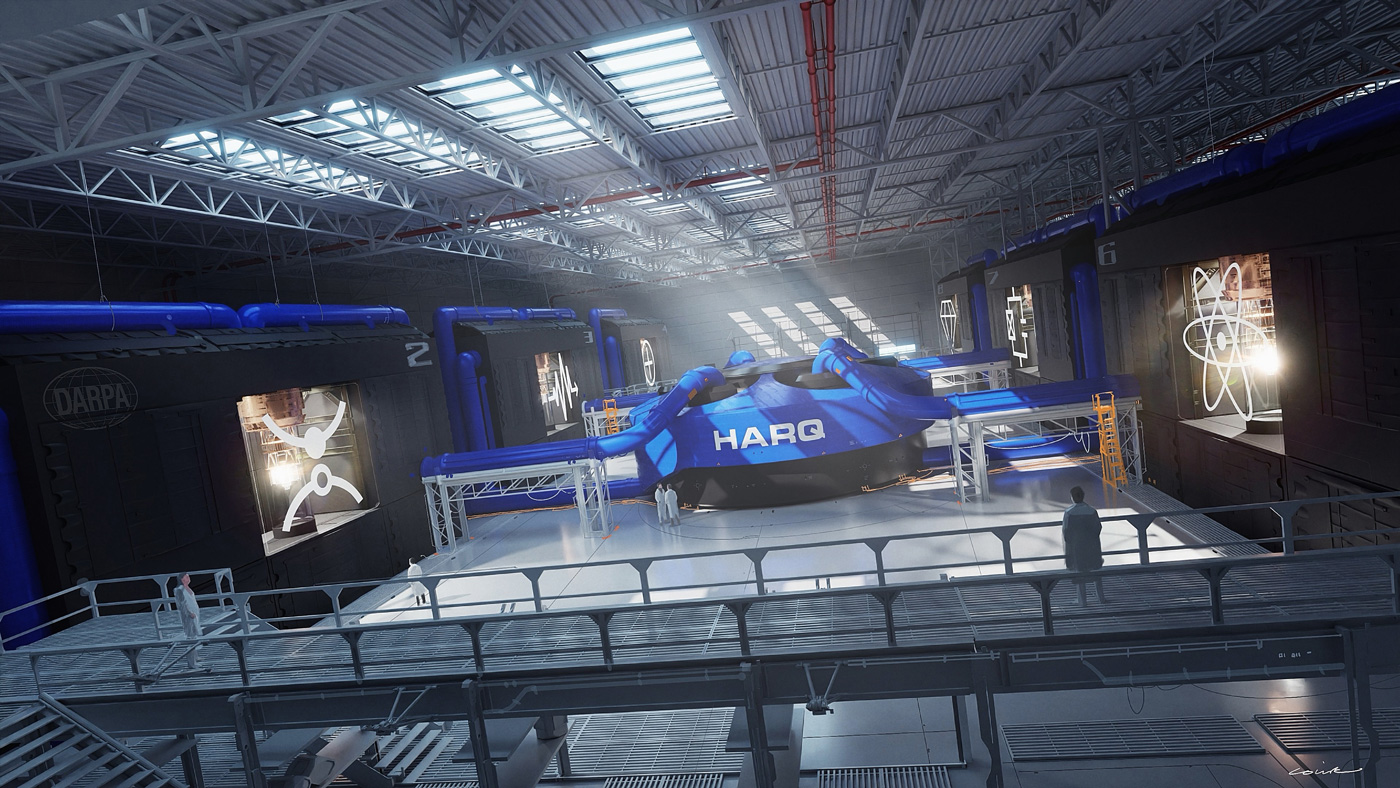
qBraid is proud to announce we are part of a DARPA-selected team led by memQ to develop a hardware and network-aware quantum compiler under the HARQ program, alongside researchers from MIT, Yale, and the University of Chicago.
.png)
Collaborations
2
Min read
Loom, the quantum error correction library from Entropica Labs, is now available on the updated qBraid Lab Explore page.

Collaborations
3
Min read
qBraid Pilots is now available on AWS Marketplace, giving enterprises a familiar procurement path to access expert-guided quantum algorithm development powered by Amazon Braket.

Collaborations
2
Min read
Access AQT’s IBEX Q1 on qBraid Lab, enabling researchers and developers to run experiments on fully connected trapped ion quantum hardware

Collaborations
3
Min read
qBraid is proud to return as the official compute platform for the 2026 Connected DMV Global Industry Challenge, announced at CES 2026 in Las Vegas.

Collaborations
3 minutes
Min read
qBraid has been selected by IBM to host their annual Qiskit Global Summer School for the second year in a row.

Collaborations
5
Min read
As an early adopter of the NVIDIA GH200 Grace Hopper Superchip systems, qBraid provides unparalleled access to today’s most advanced computing technologies.

Collaborations
1
Min read
Explore the advantages of cloud-based quantum computing and how it is revolutionizing research and development across various industries

Collaborations
1
Min read
Discover how quantum computing is revolutionizing enterprises, from enhancing cybersecurity with quantum encryption to optimizing complex logistics and supply chain operations.

Collaborations
5
Min read
qBraid’s quantum computing platform adds access to 256 qubit neutral atom quantum computer, Aquila by QuEra.

Collaborations
5
Min read
qBraid and Quantum Algorithms Institute partner to accelerate the pace of quantum computing in British Columbia and beyond.

Collaborations
4
Min read
The qBraid platform will allow users to play with Pulser in a matter of a few minutes.
Hackathons
3
Min read
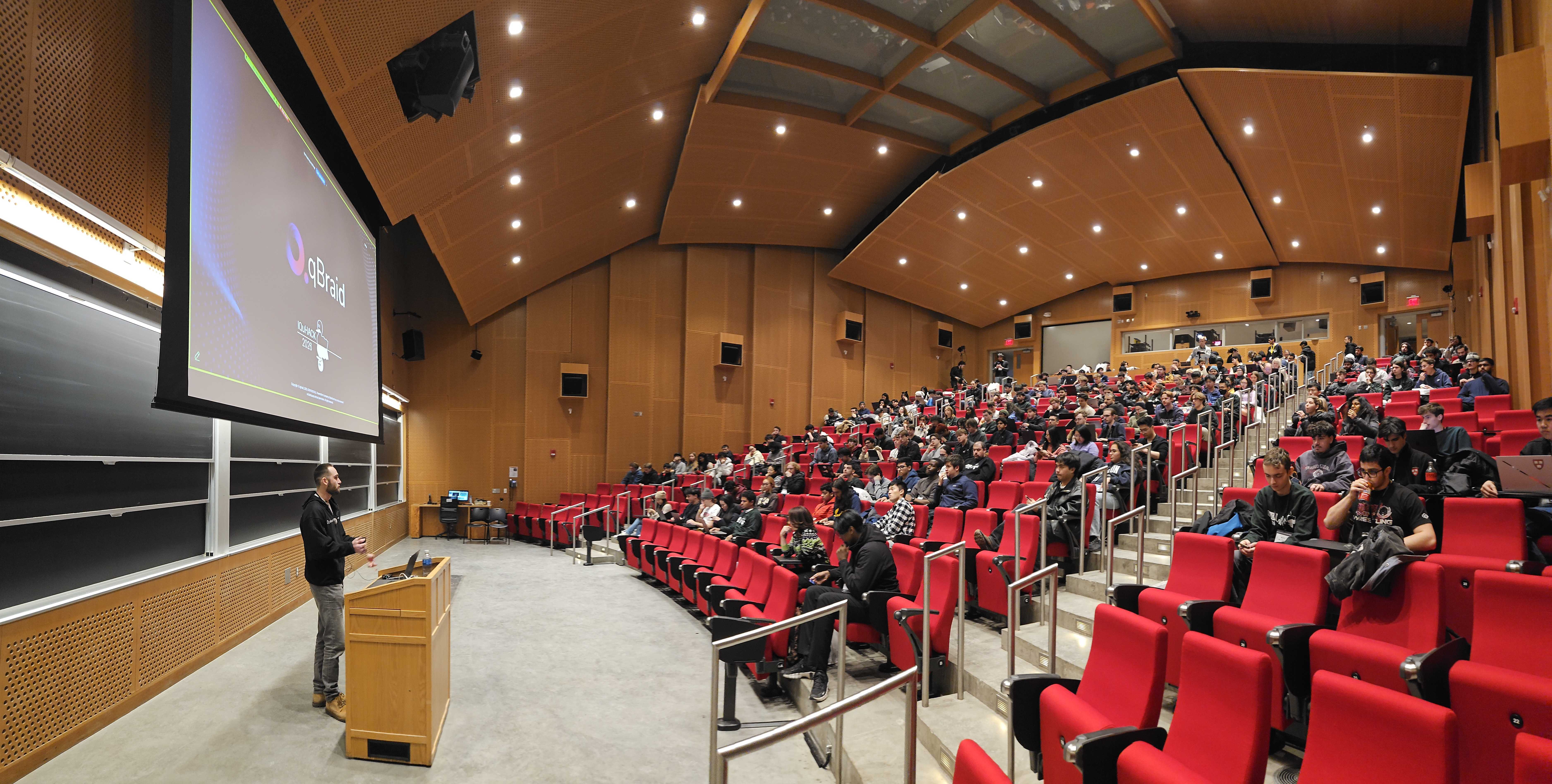
qBraid served as the official platform for iQuHACK 2026, MIT's 7th annual quantum hackathon, powering 1,400+ participants across 76 countries for the 5th consecutive year.

Hackathons
5
Min read
As part of QHack, qBraid is providing the best quantum developer notebook environment experience for challengers.

Hackathons
10
Min read
From October 21st to November 5th of 2022, qBraid hosted HAQS, one of the most popular quantum computing events of the year, where participants from around the world worked on solving a total of five quantum computing challenges during the two weeks of the event.

Hackathons
5
Min read
At this year's QCHack, participants attended a week filled with amazing talks, 1:1 sessions with academic and industry mentors, and a 24 hour hackathon hosted by Stanford, Yale and Berkeley.
-min.jpeg)
Hackathons
4
Min read
The potential of the field of quantum computing is so huge that everyone in the field cannot wait for all the promises that the field holds to become a reality.
Research
4
Min read
qBraid researchers Tarini Hardikar and James Brown presented four talks at the APS Global Physics Summit 2026 in Denver, spanning molecular simulation, quantum education, and aerospace applications.

Research
5
Min read
IEEE has awarded qBraid and its collaborators 1st place for the Best Paper Award in the Quantum Algorithm Track.
Research
1
Min read
qBraid's team used hybrid classical-quantum algorithms to determine the best flight path
Research
1
Min read
Learn how classical sampling methods, such as Markov Chain Monte Carlo, can estimate truncation errors in simulating bosons on quantum computers, aiding resource assessment and result validation for quantum simulations, including applications in two-dimensional lattice scalar field theory.

Press Releases
3
Min read
MIT News featured qBraid as a startup providing a nontechnical gateway to coding on quantum computers, highlighting the platform's mission to democratize access to quantum hardware and software worldwide.

Press Releases
2
Min read
qBraid wins NSF POSE grant to build open source ecosystem

Press Releases
10
Min read
qBraid and NVIDIA CUDA-Q are removing the two biggest blockers to AI4Quantum research

Press Releases
8
Min read
Our first cohort of the qBraid Alliance, a partnership with student organizations at leading universities around the country.

Press Releases
5
Min read
Coming from IBM Quantum Lab? Learn how to start using qBraid Lab

Press Releases
10
Min read
The Bloch develops quantum technology solutions for society’s most pressing problems by accelerating industry adoption to drive research commercialization, catapulting US leadership in quantum information science and technology.

Press Releases
5
Min read
Our newest podcast series

Press Releases
5
Min read
qBraid will lead a team of researchers from MIT, UChicago, Argonne National Laboratory, and QuEra to develop quantum computing solutions for studying the interaction of metals and intrinsically disordered proteins.

Press Releases
Min read
OSU uses qBraid for accessing Intel Quantum SDK

Press Releases
5
Min read
qBraid provides agnostic connections to quantum computers and simulators thanks to Amazon Braket

Press Releases
10
Min read
Duality Quantum Accelerator Accepts Six Startups into Inaugural Cohort

Press Releases
1
Min read
Take the QuBes (Quantum Beginners) course to learn quantum computing.

Press Releases
5
Min read
qBraid aims to increase accessibility to, and interoperability amongst, quantum computing resources.
Product
3 min read
Min read
qBraid Lab now offers on-demand access to 20+ GPU instance types across NVIDIA's Blackwell, Hopper, Ampere, and Ada Lovelace architectures, with pay-as-you-go pricing and zero infrastructure to manage.
Product
3 min read
Min read
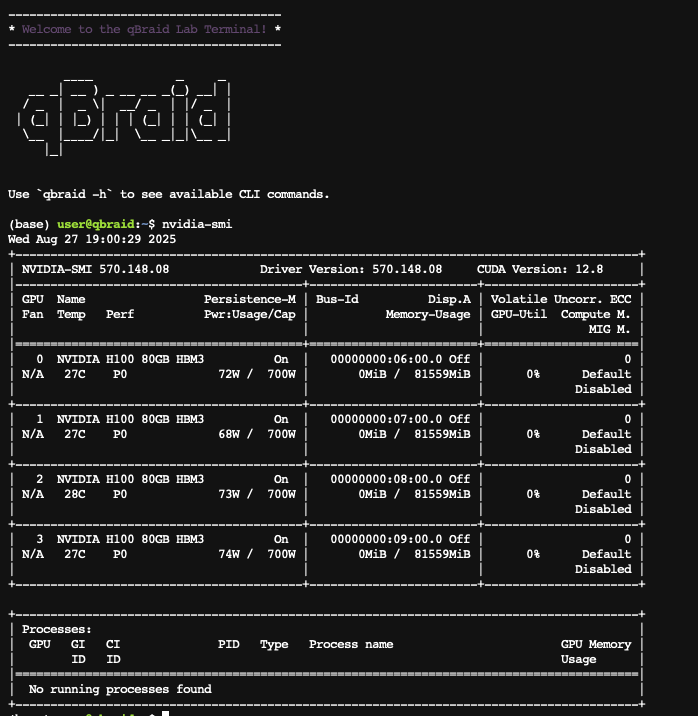
Rigetti's Cepheus-1-108Q, the largest modular quantum system in the industry, is now available to qBraid Lab users via direct integration.
Product
3 minutes
Min read
Supercharge your quantum workflows with GPUs on qBraid
.png)
Product
5
Min read
We are pleased to have presented qBraid’s Platform-Agnostic Open-Source Tools at the Quantum Computing Devroom in FOSDEM 2025.

Product
5
Min read
Accelerating hybrid workflows using Pennylane's embedded simulators with NVIDIA GPUs on qBraid Lab.

Product
5
Min read
Here are 3 ways to install python packages on qBraid

Product
2
Min read
How to install Cirq v1.2.0 environment on qBraid Lab

Product
1
Min read
Let qBraid help you take your first step into the quantum world!

Product
1
Min read
Intel® Quantum SDK is generally available on qBraid Lab for Free with no installation necessary

Product
1
Min read
Dive into the intricate interplay of the Bernoulli line and the Bloch sphere, revealing profound geometric insights into quantum state dynamics.


